Gua bao (pork belly bun) calories
刈包
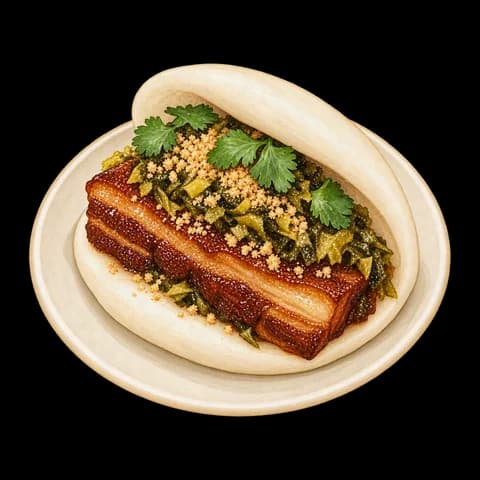
A folded steamed bun filled with braised pork belly, pickled mustard greens, sweet peanut powder and coriander.
Quick answer
A typical serving of Gua bao (pork belly bun) (1 bun with fatty braised pork belly) has about 440 kcal. Most servings fall between 320 and 550 kcal, depending on the portion and the recipe.
- Calories
- 440 kcal
- Protein
- 14 g
- Carbs
- 40 g
- Fat
- 25 g
Nutrition facts per serving
Serving: 1 bun with fatty braised pork belly, about 150 g.
| Nutrient | Amount | Share of calories |
|---|---|---|
| Calories | 440 kcal | 100% |
| Protein | 14 g | 13% |
| Carbohydrates | 40 g | 36% |
| Fat | 25 g | 51% |
Calories in common versions
| Version | Typical calories |
|---|---|
| Lean pork | 340 kcal |
| Half lean, half fatty | 390 kcal |
| 2 buns with fatty pork belly | 880 kcal |
What drives the calories
- Pork belly is the main source of fat.
- The steamed bun gives most of the carbs.
- Sweet peanut powder adds about 50 kcal.
How to make it lighter
- Ask for lean pork instead of fatty pork.
- Ask for less peanut powder.
- Have 1 bun with a clear soup instead of 2 buns.
How to log Gua bao (pork belly bun) in Nibbs
Note whether the pork is lean, fatty or mixed, because the cut changes the count by up to 100 kcal. Nibbs then estimates the portion and the calories for your actual plate, and you can edit any item before you save it.
Gua bao (pork belly bun) calorie questions
How many calories are in a gua bao?
A gua bao with fatty braised pork belly has about 440 kcal. With lean pork, it has about 340 kcal.
Is gua bao high in fat?
With fatty pork belly, yes. A bun has about 25 g of fat. Lean pork cuts both the fat and the calories.
Track Gua bao (pork belly bun) with a photo
Nibbs is the AI calorie tracker built for Asian food. Snap your plate and get calories and macros in seconds.