How to count calories in nasi campur and economy rice
By the Nibbs teamUpdated 6 min read
Quick answer
To count calories in nasi campur, add up each part of the plate: the rice by the scoop, each lauk by the piece or scoop, and the gravy. A typical plate with one meat and two vegetable dishes has about 600 kcal, and most plates fall in the range of 450-900 kcal.
How many calories are in a plate of nasi campur?
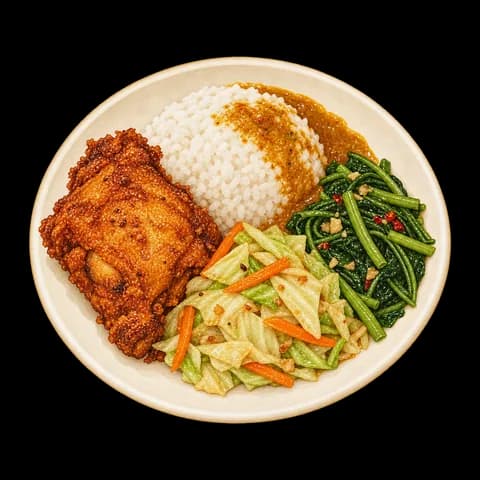
Nasi campur (economy rice, or chap fan) has no fixed recipe. You choose the lauk at the counter, so two plates from the same stall can be hundreds of calories apart. That is why it helps to count the parts, not the plate.
| Dish | Calories | Protein | Carbs | Fat |
|---|---|---|---|---|
| Nasi campur (economy rice)1 plate of rice with 1 meat and 2 vegetable dishes | 600 kcal | 25 g | 80 g | 20 g |
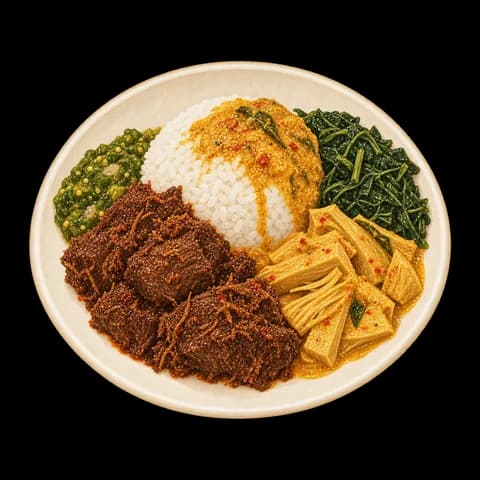 Nasi Padang1 plate: rice with rendang, jackfruit gulai, cassava leaves and sambal Nasi Padang1 plate: rice with rendang, jackfruit gulai, cassava leaves and sambal | 700 kcal | 30 g | 90 g | 24 g |
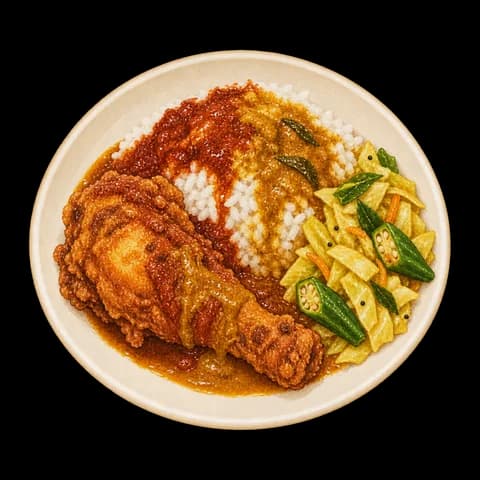 Nasi kandar1 plate with fried chicken, mixed curry gravy and vegetables Nasi kandar1 plate with fried chicken, mixed curry gravy and vegetables | 800 kcal | 32 g | 95 g | 33 g |
Nasi kandar works the same way, with more curry gravy poured over the rice. Nasi Padang is the Indonesian version, often with rendang and coconut milk curries.
How do you count nasi campur, step by step?
- Count the rice in scoops. In the Ministry of Health Malaysia (MOH) calorie list, one scoop (senduk) of white rice is 76 g and about 100 kcal. Count how many scoops the server puts on your plate.
- Name each lauk. Fried chicken, curry fish, fried egg, sambal tempe and so on. Count the pieces or the scoops.
- Count the gravy on its own. Curry or masak lemak gravy poured over the rice is easy to forget.
- Add the drink. A sweet iced drink can add as much as a lauk.
- Add it all up. Round to the nearest 10 kcal. You do not need to be exact to be useful.
Here is a worked example with MOH values: 2 scoops of rice (about 200 kcal), 1 piece of fried chicken breast (about 310 kcal), 1 scoop of kangkung goreng (41 kcal) and 1 scoop of kacang panjang goreng (40 kcal). That comes to about 590 kcal before any gravy.
How many calories are in common lauk?
Protein dishes carry most of the calories after the rice. Fried and coconut milk dishes are the heaviest.
| Lauk | Serving in the MOH list | Calories |
|---|---|---|
| White rice | 1 scoop (76 g) | About 100 kcal |
| Fried chicken (ayam goreng), breast | 1 piece (127 g) | About 310 kcal |
| Ayam masak merah | 1 serving (118 g) | About 260 kcal |
| Ayam masak kicap | 1 serving (95 g) | About 220 kcal |
| Fried tofu (tauhu goreng) | 1 piece (92 g) | About 200 kcal |
| Ikan masak asam pedas | 1 fish (70 g) | About 130 kcal |
| Omelette (telur dadar) | 1 slice (45 g) | About 130 kcal |
| Fried ikan kembong | 1 piece (50 g) | About 110 kcal |
| Fried egg | 1 egg (50 g) | About 100 kcal |
| Sambal tempe | 1 scoop (40 g) | About 100 kcal |
| Hard-boiled egg | 1 egg (50 g) | 80 kcal |
Most stir-fried vegetable dishes are light. The exceptions are vegetables cooked in coconut milk or fried in batter.
| Vegetable dish | Serving in the MOH list | Calories |
|---|---|---|
| Kangkung goreng | 1 scoop (60 g) | 41 kcal |
| Kacang panjang goreng | 1 scoop (60 g) | 40 kcal |
| Stir-fried cabbage (kobis goreng) | 1 scoop (40 g) | 37 kcal |
| Bean sprouts in oyster sauce | 1 scoop (40 g) | 38 kcal |
| Kubis masak lemak | 1 scoop (60 g) | 63 kcal |
| Labu masak lemak | 1 scoop (60 g) | 80 kcal |
| Terung goreng berlada | 1 scoop (70 g) | 80 kcal |
| Battered fried brinjal (terung goreng tepung) | 1 serving (166 g) | About 480 kcal |
How much does curry gravy add?
Gravy is the part most people miss. It soaks into the rice, so you cannot see how much you got. Curry and masak lemak gravies are made with coconut milk and oil, so a generous pour adds real calories. Dhal is one of the lighter choices: the MOH list puts half a cup of dhal curry at about 50 kcal.
Three phrases help at the counter:
- Kuah sikit: a little gravy.
- Kuah asing: gravy on the side, so you choose how much to use.
- Tak nak kuah: no gravy at all.
What does a healthier nasi campur plate look like?
The Ministry of Health Malaysia introduced the Malaysian Healthy Plate, also called suku-suku separuh (quarter, quarter, half). Fill a quarter of the plate with carbohydrates such as rice, ideally wholegrain. Fill a quarter with protein. Fill the other half with vegetables and fruit. The plate is based on a 10-inch plate, the standard size for most Malaysian adults.
At the nasi campur counter, that means one or two scoops of rice, one protein lauk and two vegetable dishes. Here is how two plates from the same counter compare.
| Part of the plate | Heavier plate | Lighter plate |
|---|---|---|
| Rice | 3 scoops, about 300 kcal | 2 scoops, about 200 kcal |
| Protein | Fried chicken breast, about 310 kcal | Ikan masak asam pedas, about 130 kcal |
| Egg | Fried egg, about 100 kcal | Hard-boiled egg, 80 kcal |
| Vegetables | Kubis masak lemak, 63 kcal | Kangkung goreng and kacang panjang goreng, 81 kcal |
| Gravy | Curry gravy over the rice, not counted | Dhal on the side, or none |
| Total | About 770 kcal plus gravy | About 490 kcal |
Is Chinese economy rice counted the same way?
Yes. Chap fan or cai fan works exactly like nasi campur: rice plus the dishes you pick. Count the rice in scoops and each dish on its own. Steamed and stir-fried dishes are usually lighter than deep-fried ones and dishes in sweet sauce.
| Economy rice dish | Serving in the MOH list | Calories |
|---|---|---|
| Stir-fried kailan | 1 scoop (60 g) | 40 kcal |
| Tofu in oyster sauce | 1 scoop (50 g) | 44 kcal |
| Sawi in oyster sauce | 1 scoop (60 g) | 66 kcal |
| Steamed egg (egg fu yong) | 1 piece (55 g) | 97 kcal |
| Sweet and sour fish | 1 fish (80 g) | About 140 kcal |
How do you log nasi campur in Nibbs?
Take a photo of your plate from above, before you mix the gravy in. Nibbs splits mixed plates such as nasi campur into each item, so the rice, the chicken and each vegetable dish are counted on their own. It uses local portion sizes for the rice and the lauk.
Check every item and portion before you save. If the server gave you two scoops of rice, change the rice to two scoops. You can also type the plate, for example "nasi campur: 2 scoops rice, ayam masak merah, kangkung, kacang panjang". If you eat the same plate most weekdays, save it as a saved food and log it again with one tap.
For other plates, see our dish calorie pages or the guide to estimating portions without a scale.
Frequently asked questions
How many calories are in nasi campur?
A typical plate of nasi campur (1 plate of rice with 1 meat and 2 vegetable dishes) has about 600 kcal. Most plates fall in the range of 450-900 kcal, depending on the rice, the lauk and the gravy.
How many calories are in one scoop of rice?
In the Ministry of Health Malaysia calorie list, one scoop (senduk) of white rice is 76 g and about 100 kcal. Count the scoops on your plate and multiply.
What is the lowest calorie lauk at a nasi campur stall?
Stir-fried vegetables such as kangkung, kacang panjang and cabbage are about 40 kcal a scoop in the MOH list. For protein, a hard-boiled egg (80 kcal) or ikan masak asam pedas (about 130 kcal) is lighter than fried chicken.
Is nasi campur healthy?
It can be. Follow the Malaysian Healthy Plate: half vegetables, a quarter rice and a quarter protein. Choose grilled, steamed or asam dishes over deep-fried ones, and ask for kuah sikit or kuah asing.
Count your next meal with a photo
Nibbs is the AI calorie tracker built in Malaysia for Asian food. Take a photo of your plate and get calories, protein, carbs and fat in seconds. You can edit every item before you save it.
More guides
- Mamak food calories: what to order and what to skipRoti canai, mee goreng, nasi kandar and teh tarik compared, with lighter orders that still taste like mamak.
- How to estimate portion sizes without a food scaleUse your hand, a rice bowl, a senduk and your plate to judge portions well enough to count calories.
- How to lose weight eating Malaysian foodKeep eating local food: how a calorie deficit works with Malaysian meals, simple swaps and a sample day.
- Hawker meals under 500 calories in Malaysia and SingaporeAssam laksa, wantan mee, wonton noodle soup and more hawker meals that stay under 500 kcal, and what pushes a plate over.