Kare-kare calories
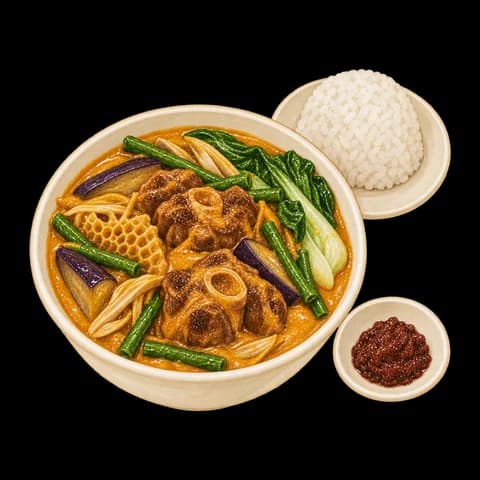
Oxtail and beef tripe stewed in a thick peanut sauce coloured with annatto, with eggplant, string beans, banana blossom and pechay, served with shrimp paste (bagoong) and rice.
Quick answer
A typical serving of Kare-kare (1 bowl of oxtail kare-kare with bagoong, plus 1 cup of rice) has about 630 kcal. Most servings fall between 500 and 850 kcal, depending on the portion and the recipe.
- Calories
- 630 kcal
- Protein
- 36 g
- Carbs
- 60 g
- Fat
- 28 g
Nutrition facts per serving
Serving: 1 bowl of oxtail kare-kare with bagoong, plus 1 cup of rice, about 410 g.
| Nutrient | Amount | Share of calories |
|---|---|---|
| Calories | 630 kcal | 100% |
| Protein | 36 g | 23% |
| Carbohydrates | 60 g | 38% |
| Fat | 28 g | 40% |
Calories in common versions
| Version | Typical calories |
|---|---|
| Kare-kare only, no rice | 420 kcal |
| Crispy pork kare-kare with rice | 820 kcal |
| Seafood kare-kare with rice | 540 kcal |
What drives the calories
- The peanut sauce gives a large part of the fat.
- Oxtail is a fatty cut, and the fat around the bone adds calories.
- Bagoong adds sodium and some fat, about 30 kcal per tablespoon.
How to make it lighter
- Take more vegetables and less sauce.
- Use a small amount of bagoong.
- Leave the fat around the oxtail on the plate.
How to log Kare-kare in Nibbs
Log the kare-kare, the rice and the bagoong as separate items so you can change each portion. Nibbs then estimates the portion and the calories for your actual plate, and you can edit any item before you save it.
Kare-kare calorie questions
How many calories are in kare-kare?
A bowl of oxtail kare-kare with bagoong and 1 cup of rice has about 630 kcal. Without rice, the kare-kare has about 420 kcal. Crispy pork kare-kare with rice has about 820 kcal.
Is kare-kare high in protein?
Yes. A bowl with rice has about 36 g of protein from the oxtail, tripe and peanuts. It also has about 28 g of fat.
Track Kare-kare with a photo
Nibbs is the AI calorie tracker built for Asian food. Snap your plate and get calories and macros in seconds.